 is your investment to the Victory and future of Ukraine


30.06.2026
Five Days of International Dialogue. Every meeting held over the week, despite their different formats, revolved around a single theme: how to build a capital market that operates under European rules, attracts private investment, and becomes one of the foundations of Ukraine’s economic recovery. Whereas international partners once focused on helping Ukraine establish its core financial institutions, today they are discussing, together with Ukraine, the architecture of its future financial market. This is perhaps the clearest indication of how Ukraine’s role in the international financial dialogue has changed.
Just a few years ago, international partners were primarily concerned with whether Ukraine would be able to preserve the stability of its financial system during wartime and whether the regulator had sufficient authority to support it. Today, the conversation has changed.
European regulators, international financial institutions, and prospective investors are now asking different questions: What will Ukraine’s capital market look like after the war? How will it integrate into the European financial landscape? And can it become one of the key drivers of the country’s economic recovery?
These were the central topics of the international working week of Oleksii Semeniuk, Chairman of the National Securities and Stock Market Commission (NSSMC).
First, a meeting took place in Frankfurt with Mark Branson, President of the the Federal Financial Supervisory Authority, BaFin, where the parties agreed to expand cooperation in the areas of capital market supervision, the development of post-trading infrastructure, the use of data for supervisory purposes, and investor protection.
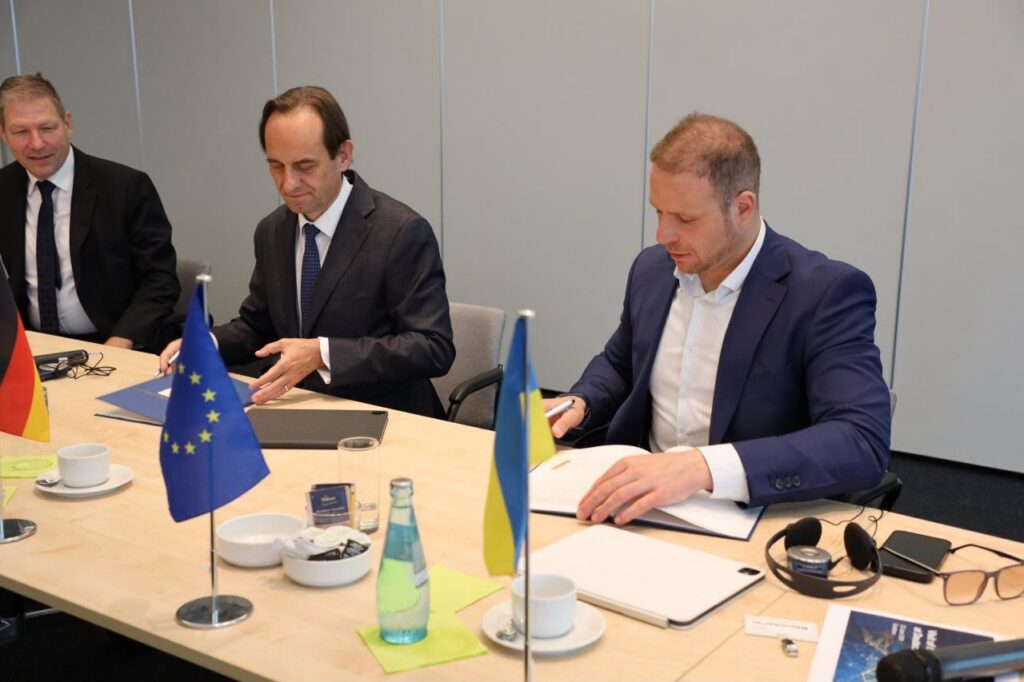
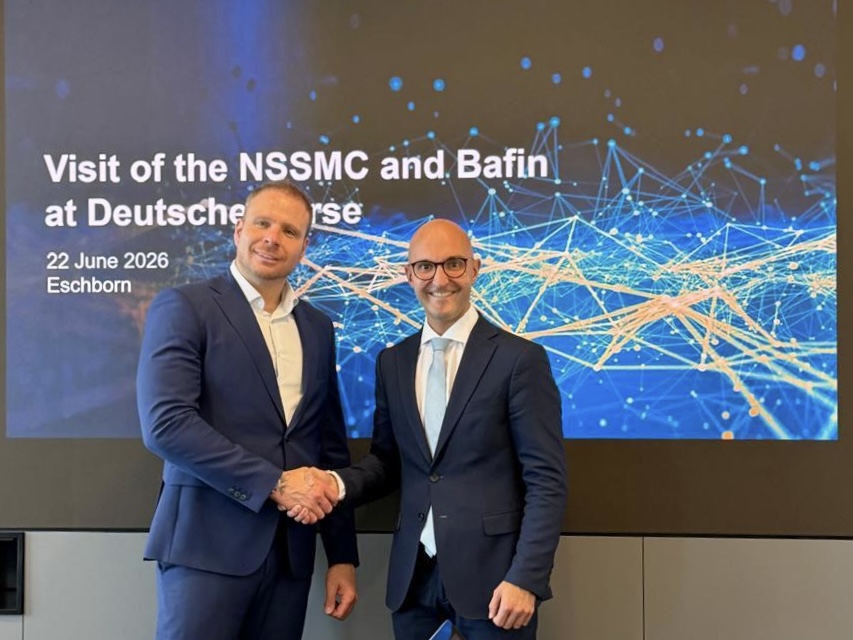
The next stage was a visit to Deutsche Börse Group, where discussions moved beyond individual regulatory initiatives to focus on the future architecture of Ukraine’s capital market: the development of depository infrastructure, integration of digital financial instruments, cooperation with international index providers, and preparing the Ukrainian market to operate in line with European standards.
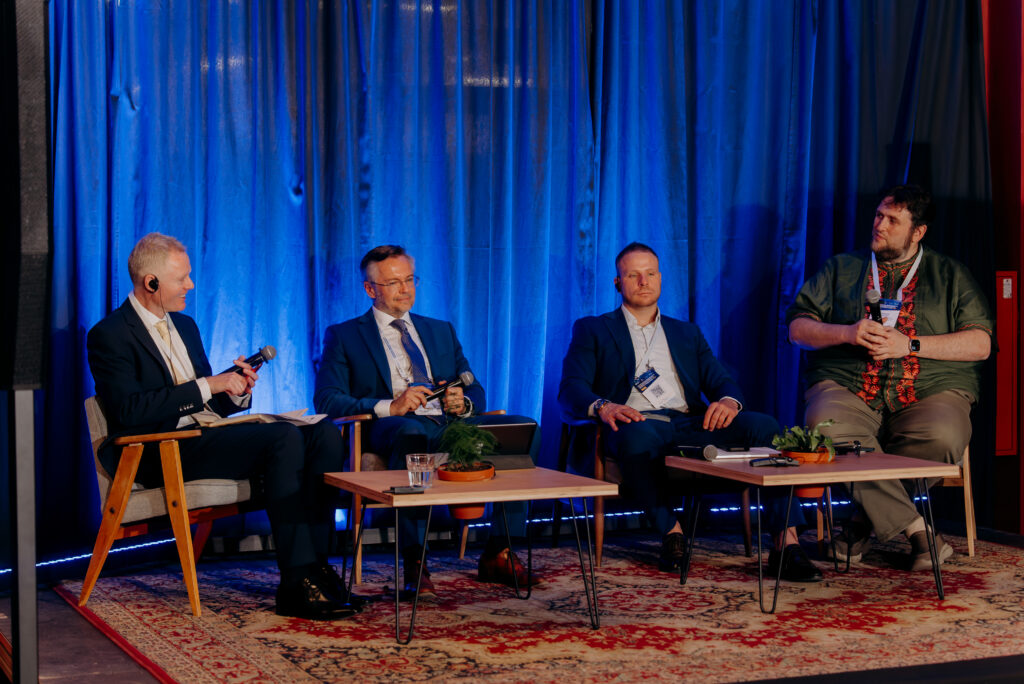
A logical continuation was the Ukrainian delegation’s participation in the Ukraine Recovery Conference 2026 in Gdańsk, where the central topic was implication private capital for Ukraine’s reconstruction. It was there that it became evident that capital market development is no longer viewed merely as a specialized reform, but as a key instrument for the state’s economic recovery.
The international week concluded with a closed-door discussion involving international investors and representatives of the global financial community. More than any other event, this discussion demonstrated how perceptions of Ukraine have changed.
Instead of broad questions about the country’s stability, participants focused on the practical details of reform.
• How is the NSSMC reducing regulatory discretion?
• How will MiCA-aligned regulation of virtual assets coexist with the powers of the National Bank of Ukraine?
• How does Ukraine plan to transform domestic household savings into long-term investment capital?
• Will the reforms remain resilient after the war has ended?
In other words, today international partners are no longer assessing whether Ukraine’s capital market can exist—they are evaluating the quality of the model that will shape its future.
Ukraine has a clear answer to these questions.
The NSSMC is already implementing a set of reforms to harmonize Ukrainian legislation with European law. These reforms cover areas such as virtual assets and securitization, the modernization of the regulator’s own structure, the digitalization of processes, and the introduction of modern supervisory tools. A significant portion of these changes forms part of Ukraine’s international commitments to the European Union and the International Monetary Fund and is subject to clear performance benchmarks.
For this reason, the discussion generated the most interest around answers to practical questions regarding the future of the Ukrainian capital market.
Why should investors consider Ukraine?
“Ukraine is one of Europe’s most undervalued investment opportunities. Reconstruction is creating unprecedented demand for capital, while European integration means adopting European Union rules under the oversight of international institutions.
Those who invest today have the opportunity to enter the market before its full-scale growth begins.”
Ukraine’s stock market is barely functioning. Why should that change?
“The challenge is not merely the size of the market—it is the structure of incentives. Today, most capital is directed toward government debt instruments. The NSSMC is working to create the conditions necessary for the development of individual investment accounts, securitization, funded pension schemes, and other long-term investment instruments.
A capital market begins to function effectively when the right incentives are in place.”
Are reforms progressing too slowly?
“We are implementing these reforms under the conditions of a full-scale war while simultaneously carrying out structural changes that form part of Ukraine’s international commitments. Their implementation is being assessed by both the European Union and the IMF.
Our objective is not rapid decisions but irreversible reforms.”
How will investors be protected?
“Investor protection begins with clear and transparent rules. We are consistently reducing opportunities for discretionary intervention, digitalizing regulatory processes, and introducing European standards for disclosure.
The most effective anti-corruption mechanism is a transparent regulatory framework that applies equally to everyone.”
Won’t regulation hinder innovation?
“Innovation does not require an absence of rules—it requires predictability. That is precisely why we are developing the regulatory framework for virtual assets in line with the European MiCA model.
Capital flows where the rules of the game are clear.”
What happens after the war and once international support programs come to an end?
“The strongest guarantee that reforms will endure is their integration into European legislation. These reforms are no longer solely a matter of Ukraine’s domestic policy—they have become an integral part of our path toward European Union membership.
Every stage of reform represents a shared commitment between Ukraine and the European Union.”
What is the greatest challenge facing Ukraine’s financial sector today?
“Ukraine must learn how to transform domestic household savings into long-term investment capital.
No country can rebuild its economy solely through the state budget or international assistance. Sustainable recovery requires private capital—and private capital goes where trust exists.”
Where do you see the NSSMC five years from now?
“We envision the National Securities and Stock Market Commission as a modern European regulator, fully integrated into the international system of financial supervision, while Ukraine’s capital market should become liquid, technologically advanced, and capable of financing the country’s long-term economic development.
Our goal is to evolve from a regulator striving to catch up with the world into one that engages with global partners as an equal.”
It is telling that every international meeting held throughout the week—regardless of its format—ultimately focused on the same overarching issue. The discussion was not about individual draft laws or isolated technical amendments, but about the kind of capital market Ukraine should build after the war.
Only a few years ago, Ukraine’s international partners were helping the country establish its core financial institutions. Today, they are working alongside Ukraine to design the architecture of its future financial system. This is perhaps the strongest evidence of how profoundly Ukraine’s place in the international financial dialogue has evolved.
Viewed from a broader perspective, every meeting was essentially about the same objective: ensuring that Ukraine does not merely restore its financial system, but builds one that is modern, fully compatible with the European Union, and capable of supporting the technologies and financial innovations of the future.
Background
• BaFin and the Financial Conduct Authority (FCA) are helping answer the question: «What should a modern financial regulator look like?»
• Deutsche Börse, London Stock Exchange Group (LSEG), and Clearstream are addressing: «What should the infrastructure of Ukraine’s capital market look like?»
• FTSE Russell is contributing to the question: «How can Ukraine’s capital market become visible and attractive to global investors?»
• European Securities and Markets Authority (ESMA) and the International Organization of Securities Commissions (IOSCO) are helping define: «Which international standards should govern Ukraine’s capital market?»
• The International Monetary Fund (IMF), the Organisation for Economic Co-operation and Development (OECD), and the European Bank for Reconstruction and Development (EBRD) are focused on: «How can these standards be translated into tangible reforms and sustainable economic growth?»
That is precisely why all these meetings appear as a unified strategy rather than a series of separate international visits.
Зв'язатися з нами